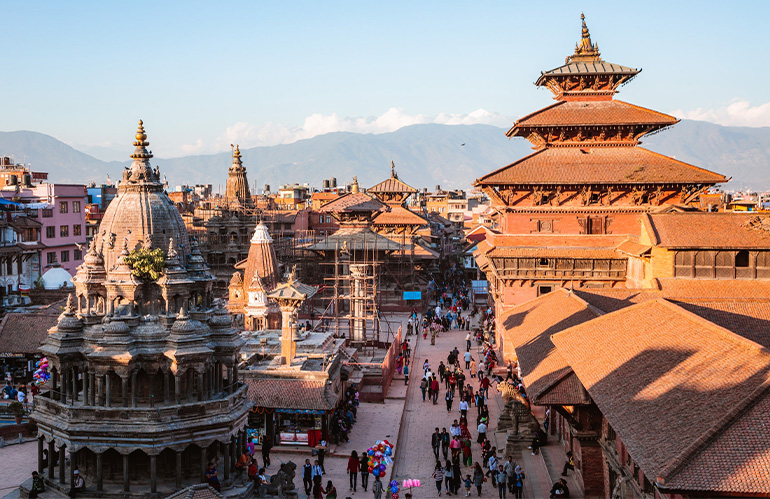
Nepal, formerly the Federal Democratic Republic of Nepal is a landlocked country in South Asia. It is mainly situated in the Himalayas, but also includes parts of the Indo-Gangetic Plain, bordering Tibet of China to the north, and India in the south, east, and west. Nepal has a diverse geography, including fertile plains, subalpine forested hills, and eight of the world’s ten tallest mountains, including Mount Everest, the highest point on Earth. Nepal is a multi-ethnic, multi-lingual, multi-religious and multi-cultural state, with Nepali as the official language. Kathmandu is the nation’s capital and the largest city.
In the middle of the first millennium BC, Gautama Buddha, the founder of Buddhism, was born in Lumbini in southern Nepal. The Constitution of Nepal, adopted in 2015, affirms the country as a secular federal parliamentary republic divided into seven provinces. Nepal was admitted to the United Nations in 1955.
Geography:
Nepal is of roughly trapezoidal shape, about 800 kilometers (500 mi) long and 200 kilometers (120 mi) wide, with an area of 147,516 km2 (56,956 sq mi). Mount Everest, the highest peak on earth, lies on the Nepal–China border. Nepal experiences five seasons: summer, monsoon, autumn, winter and spring. The Himalayas block cold winds from Central Asia in the winter and form the northern limits of the monsoon wind patterns.
Economy:
Nepal’s gross domestic product (GDP) for 2019 was $34.186 billion. With an annual growth rate calculated at 6.6% in 2019, and expected 2.89% in 2021, Nepal is one of the fastest-growing economies in the world. The country ranks 165th in the world in nominal GDP per capita and 162nd in GDP per capita at PPP. Nepal has been a member of WTO since 23 April 2004.
The 16.8-million-worker Nepali labour force is the 37th largest in the world. The primary sector makes up 27.59% of GDP, the secondary sector 14.6%, and the tertiary sector 57.81%. Nepal’s foreign exchange remittances of US$8.1 billion in 2018, the 19th largest in the world and constituting 28.0% of GDP, were
Nepal has made significant progress in poverty reduction bringing the population below the international poverty line (US$1.90 per person per day) from 15% in 2010 to just 9.3% in 2018, although vulnerability remains extremely high, with almost 32% of the population living on between US$1.90 and US$3.20 per person per day. Nepal has made improvement in sectors like nutrition, child mortality, electricity, improved flooring and assets. Under the current trend, Nepal is expected to eradicate poverty within 20 years.
The government’s budget is about $13.71 billion (FY 2019/20); expenditure of infrastructure development budget, most of it contributed by foreign aid, usually fails to meet the target. The country receives foreign aid from the UK, India, Japan, the US, the EU, China, Switzerland, and Scandinavian countries.
Tourism:
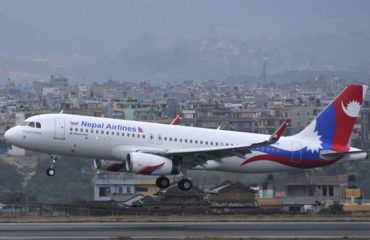
Tourism is one of the largest and fastest-growing industries in Nepal, employing more than a million people and contributing 7.9% of the total GDP. The number of international visitors crossed one million in 2018 for the first time (not counting Indian tourists arriving by land). Nepal, officially opened to westerners in 1951, became a popular destination at the end of the hippie trail, during the 1960s and 1970s. The industry, disrupted by the civil war in the 1990s, has since recovered but faces challenges to growth, owing to a lack of proper facilities for high-end tourism termed the “infrastructure bottleneck”, the flag carrier in shambles, and a handful of destinations properly developed and marketed. The home-stay tourism, in which cultural and eco-tourists stay as paying guests in the homes of indigenous people, has seen some success.
Foreign employment:
Nepal has a long history of labour migration. For around 200 years, Nepali men (and to a lesser extent women) have been leaving their homes to seek employment and living abroad. The rate of unemployment and underemployment exceeds half of the working-age population driving millions to seek employment abroad, mainly in India, the Gulf, and East Asia.
Plans for Nepal’s development have tended to pay attention to foreign labour migration and flows of remittances back home; thanks to evidence of their substantial importance to rural households. In the last decade the Nepalese government has recognized the significance of labour migration and remittances to the national economy. The government has shown some interest in developing institutional mechanisms to deal with labour migration and in channelling remittances through banks, not least because these represent a huge source of foreign exchange and income in the form of tax.
Recent research generated information and data to reveal the extent of Nepal’s dependency on foreign labour employment and remittances is over 27% of GDP. A labour force that is growing by around half a million every year in the Nepal job market and around 300,000 people find a job in the international market. Foreign labour employment plays an important role in absorbing a growing labour force
Demographics:
The citizens of Nepal are known as Nepali or Nepalese. Nepal is a multicultural and multiethnic country, home to 125 distinct ethnic groups, speaking 123 different mother tongues and following a number of indigenous and folk religions in addition to Hinduism, Buddhism, Islam and Christianity. According to the 2011 census, Nepal’s population was 26.5 million, almost a threefold increase from nine million in 1950. The census also noted some 1.9 million absentee people, over a million more than in 2001; most are male labourers employed overseas.
Nepali is an official language of the country. The major languages of Nepal according to the 2011 census are Nepali (44.6%), Maithili (11.7%), Bhojpuri (6.0%), Tharu (5.8%), Tamang (5.1%). Descendant of Sanskrit, Nepali is written in Devanagari script. It is the official language. Many Nepalese understand and can speak Hindi. Thanks to the new education system, many youths can communicate well or at least understand English.
Nepal is a secular country ‘means religious, cultural freedom, along with the protection of religion.’ The 2011 census reported that the religion with the largest number of followers in Nepal was Hinduism (81.3% of the population), followed by Buddhism (9%); the remaining were Islam (4.4%), Kirant (3.1%), Christianity (1.4%).